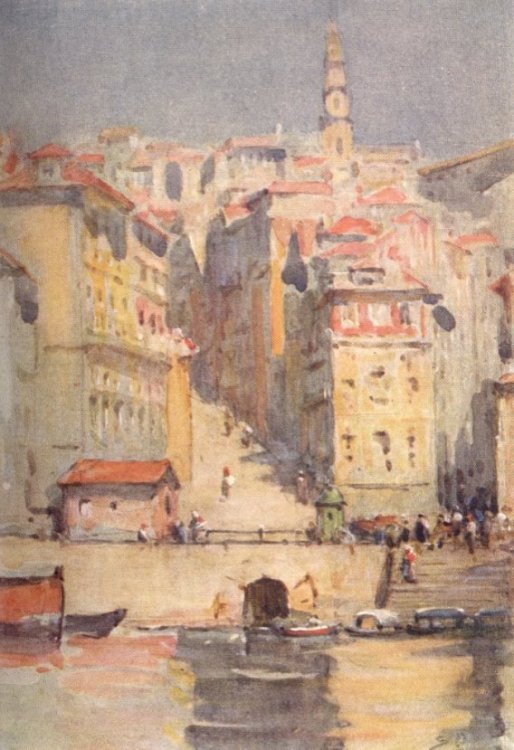
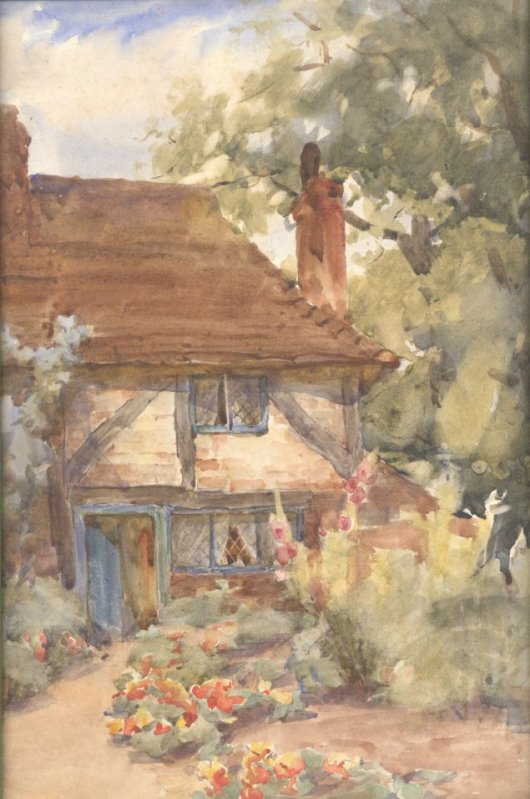
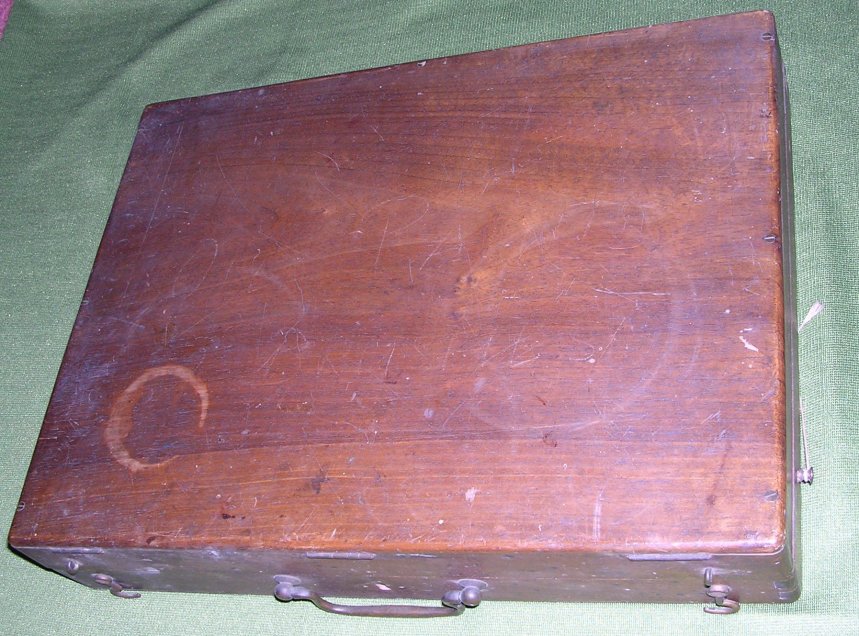
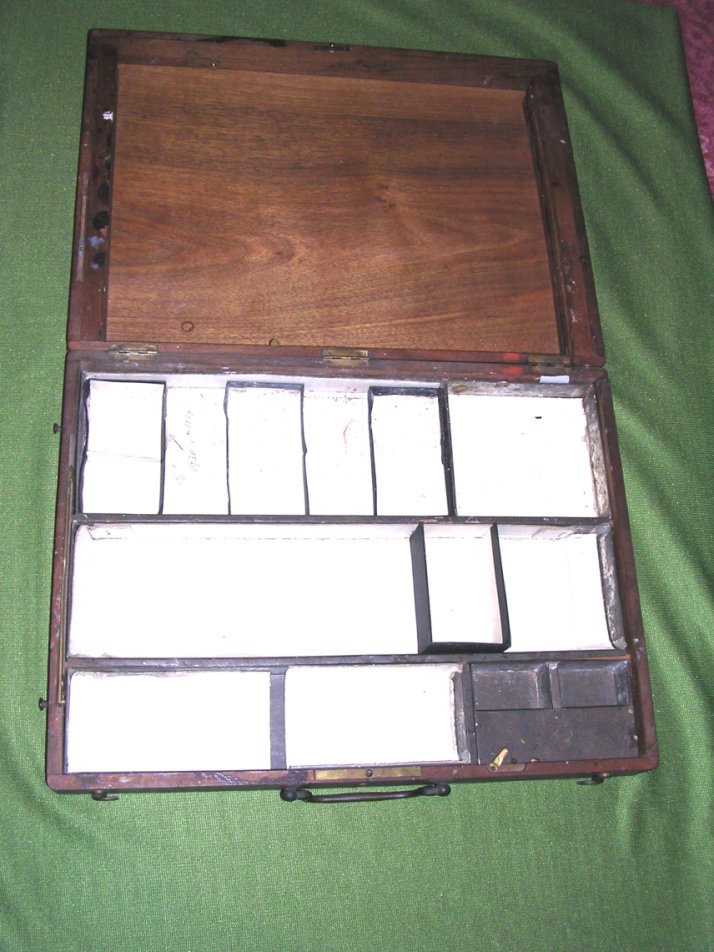
Susanna's working method was shaped by practicality, discipline, and a deep respect for what she saw. She was not an artist who invented scenes or rearranged reality for effect. Her approach was observational, economical, and rooted in the habits she had developed in Haslemere and refined in Portugal. She travelled lightly, worked quickly, and relied on a small set of tools that allowed her to paint wherever she happened to be - on a terrace, beside a road, in a village lane, or on the banks of the Douro.
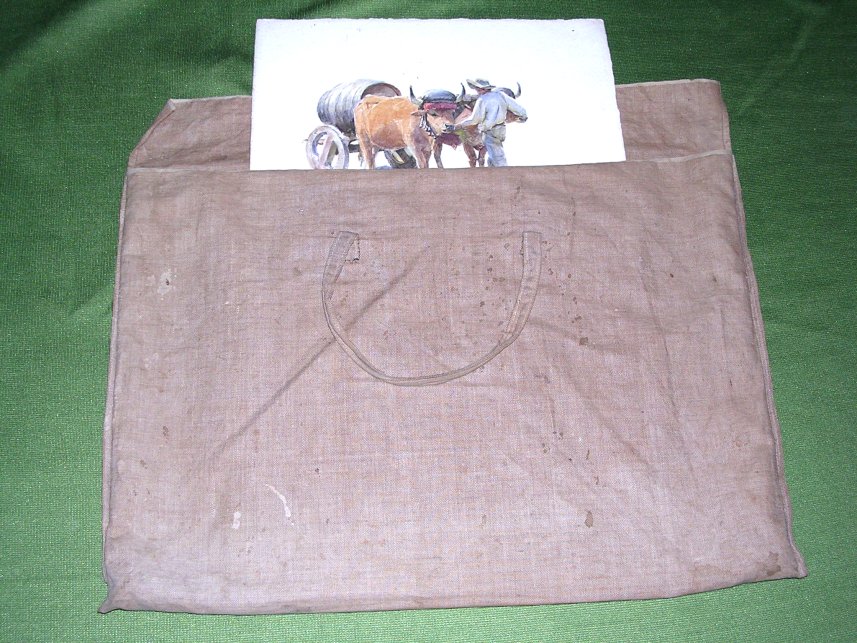
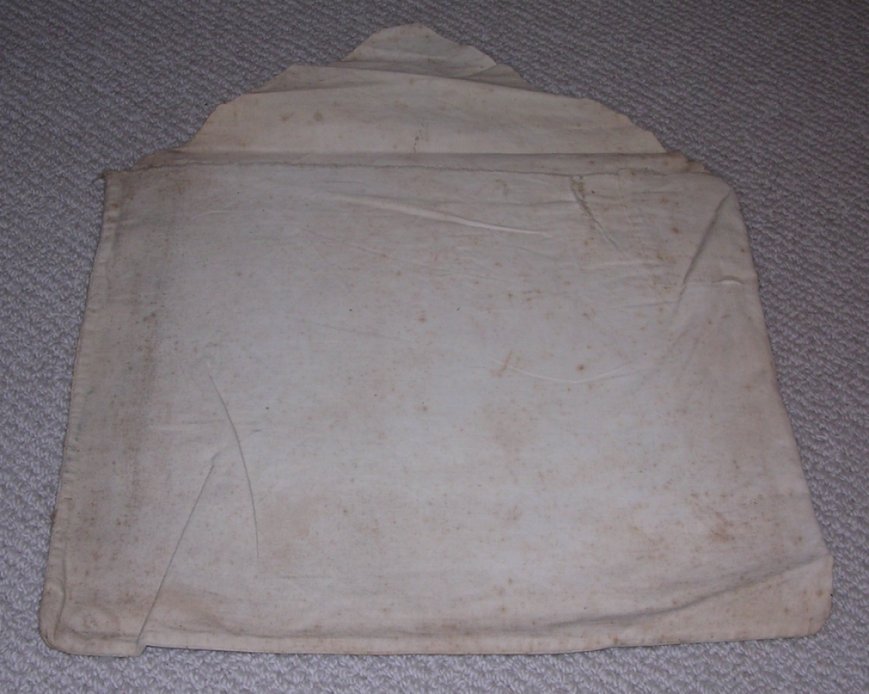
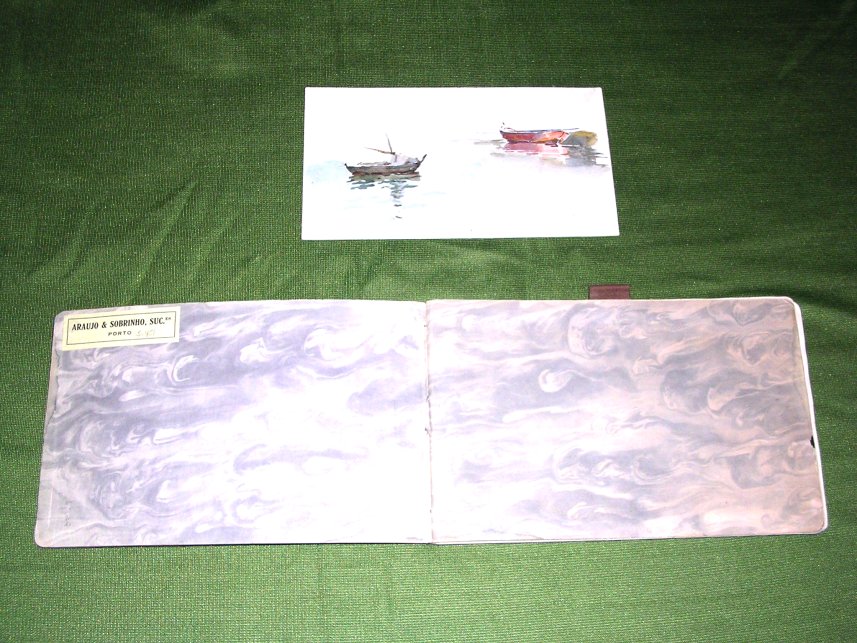
Her method was built around mobility. She carried only what she needed: her paint box, sketch pad, cloth bags, and a few brushes and pencils. This simplicity allowed her to work in places that were visually rich but not always comfortable - railway platforms, dusty roads, steep terraces, or crowded village squares. She painted what was in front of her, without staging or embellishment, and her equipment reflects this honesty. It was the kit of a travelling watercolourist, designed for speed, clarity, and direct observation.
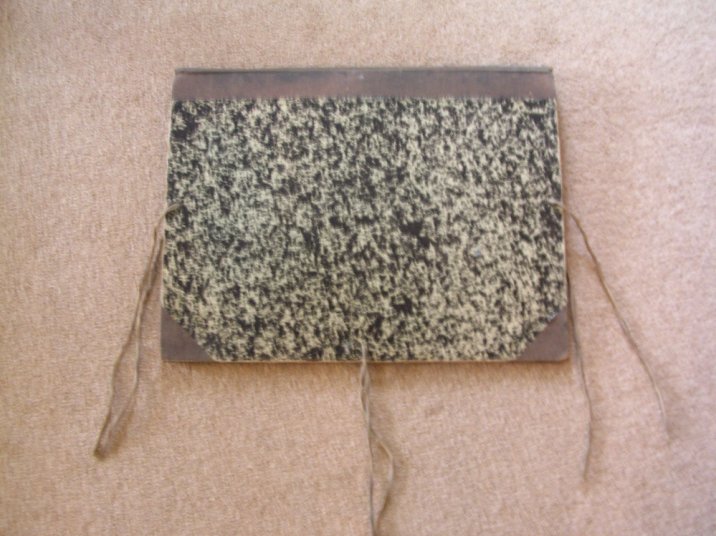
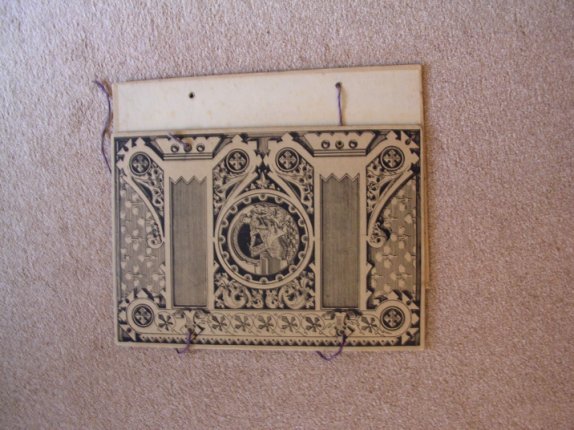
Her surviving equipment gives us a rare glimpse into her working life. These objects - worn, practical, and unpretentious - show how she organised her materials and how she approached her subjects. They also reveal the continuity between her Surrey years and her Portuguese work: the same paint box, the same sketch pad, the same cloth bags, used in two very different landscapes but with the same disciplined method.
Before May's death in 1976, the family home was sold and many of Susanna's paintings and belongings were distributed among her children. It was at this stage that further works and items passed to Bernard. When my father died in 1995, I inherited the mahogany box, the metal paint box, the pastel box, and many more paintings. Other members of the family also received paintings and equipment once belonging to Susanna. Bernard had a spell at painting in the 1930s, and two works are attributed to him. The box of Reeves’ Greyhound Pastels dates from the 1930s and therefore cannot have been passed down by Susanna.
Although the collection has travelled through several generations - and one or two items, such as the pastel box, were added later - the core objects are unmistakably hers. The paint box, the sketch pad, the cloth bags, and the tied folders match the working habits visible in her paintings: small portable sheets, rapid studies, careful colour mixing, and a disciplined, economical approach. Together they form a cross-section of the tools she relied on, minus an easel or stool, and they help us understand how she organised her materials, how she travelled, and how she prepared her colours on site.
Distance and Perspective - Structure
Susanna's paintings show a consistent and thoughtful handling of distance and perspective, shaped by her habit of working directly from life. She rarely used formal, academic perspective systems; instead, she relied on careful observation, placing each element according to what she saw rather than what theory prescribed. This gives her work a natural, unforced sense of depth.
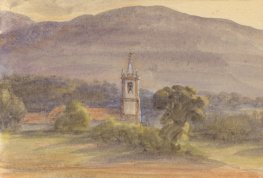
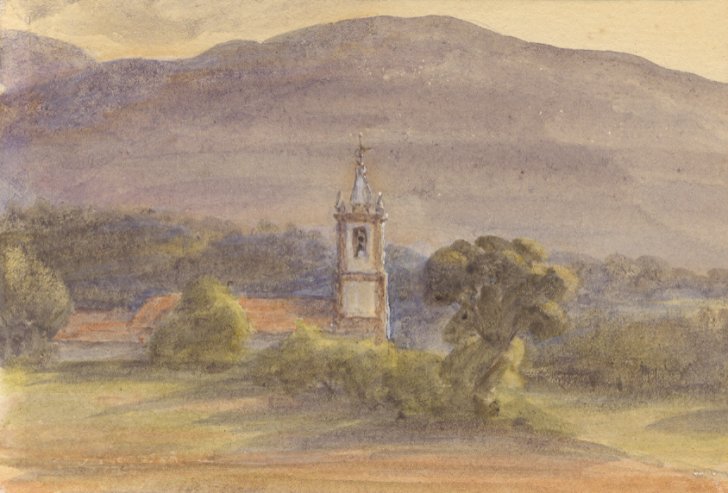
srd264: "Church at Villa do Frasos Corvas, Affife".
srd264 - Unidentified Rural Church, Afife Hinterland. In this painting, Susanna’s handling of distance is particularly clear. The church tower stands in firm, warm detail in the foreground, while the surrounding trees and hamlet buildings recede gently into softer tones. Beyond them, the hills rise in muted purples and browns, their forms reduced to simple shapes that convey depth without relying on strict linear perspective. The transition from foreground clarity to background softness is achieved through careful modulation of colour temperature and tone, creating a natural sense of space. The sky, quiet and lightly modelled, provides a calm upper register that stabilises the composition. This painting shows how Susanna used atmospheric recession rather than architectural precision to organise her landscapes, giving them a believable depth and a quiet, rural serenity.
Susanna's approach to spatial arrangement - She frequently chose viewpoints that were slightly elevated or offset, allowing her to show both the immediate action and the wider setting. This is especially visible in her Minho village scenes, where she balances the intimacy of daily life with the broader landscape. Her perspective is therefore not mathematical but experiential - a record of how space feels when encountered on foot, at eye level, and in motion. The result is a distinctive spatial rhythm: foreground detail, middle‑distance structure, and background atmosphere, all held together by her disciplined sense of proportion. Her approach to distance and perspective reinforces the honesty of her method and the clarity of her observation.
Susanna's strength - lies in her ability to observe and record space with clarity and honesty. She consistently anchors her compositions with a strong foreground element, then guides the eye through a carefully organised middle distance and into a softened background. This natural spatial rhythm gives her work coherence and stability. Her slightly elevated viewpoints, her disciplined sense of proportion, and her reliance on tonal recession rather than strict linear rules all contribute to a perspective that feels lived rather than constructed. These qualities reflect her habit of painting directly from life and her confidence in what she saw.
Susanna's weaknesses - are modest and largely the result of her working method. Because she avoided formal academic perspective, some complex scenes show minor inconsistencies in scale or alignment, especially when many figures or architectural elements are involved. On occasion, her backgrounds can become too soft or simplified, reducing the sense of depth she usually achieves so well. These are not failings of technique so much as the natural limitations of an artist who prioritised immediacy and observation over theoretical precision.
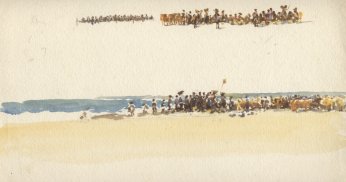
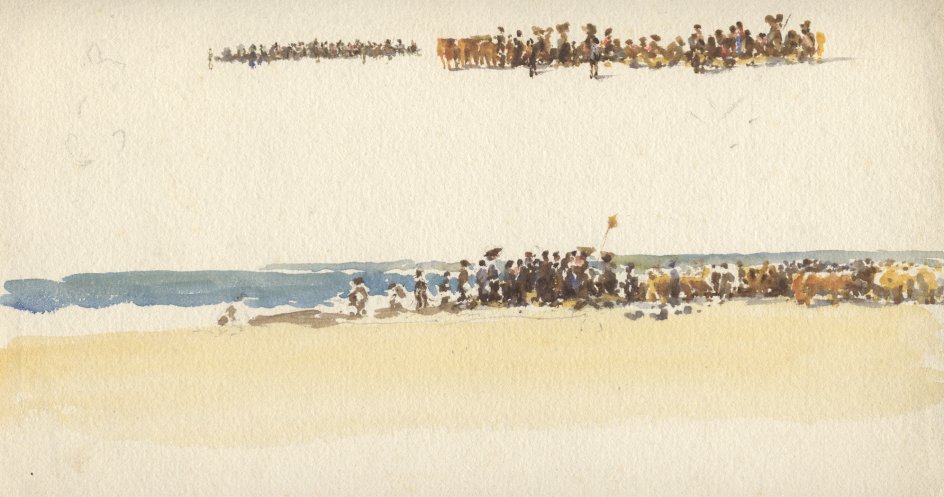
srd185: Crowd on the Beach.
This sheet is not a finished painting but an exploratory study in which Susanna tests how figures behave at different distances. She experiments with three spatial registers - far, middle, and near - placing tiny silhouettes, mid-scale groups, and larger foreground figures across the page. The result is intentionally uneven, revealing both her curiosity and her limitations. The distant groups are convincing, but the crowded middle distance becomes compressed, and the relationship between the scales is not fully resolved. As a working experiment, srd185 is valuable because it shows her thinking process: she was willing to attempt complex spatial arrangements even when they lay beyond her usual, more natural observational perspective.
Use of Colour
Susanna's colour is one of the defining strengths of her art. It is the first thing that distinguishes her work from the anonymous watercolours of her period, and it is often the quickest way to recognise her hand. Her palette is disciplined but never dull, warm without sentimentality, and consistent across decades of painting in both Surrey and Northern Portugal.
Palette - She worked with a restrained, harmonious palette built around earth tones, soft greens, warm ochres, and gentle blues. These colours reflect her habit of painting directly from life: she recorded what she saw, but always with a quiet refinement that avoided harsh contrasts or artificial intensification. Even in her Portuguese scenes, where the light is stronger and the colours more saturated, she maintains a controlled balance. Her palette is therefore recognisable not for flamboyance but for steadiness and truthfulness.
Temperature - Susanna's colour temperature is one of her most subtle achievements. She moves confidently between warm and cool passages to create depth, atmosphere, and emotional tone. Warm foregrounds often lead into cooler middle distances and softened blue‑grey backgrounds, giving her landscapes a natural sense of air and space. This modulation of temperature is one of the reasons her paintings feel so calm and believable. It is also one of the qualities that makes her work stand out when you encounter it unexpectedly: the temperature is always right.
Consistency - Across her entire body of work, Susanna’s colour is remarkably consistent. Whether painting a Surrey lane or a Minho hillside, she uses the same disciplined approach: gentle transitions, balanced tones, and a refusal to exaggerate. This consistency is one of the strongest indicators of authorship. Her palette has a quiet signature - not loud, but unmistakable once learned.
Occasional Boldness - Although her colour is usually restrained, Susanna was not afraid of boldness when the subject demanded it. In some Portuguese works she introduces stronger reds, deeper greens, or more pronounced shadows, but always with control. These moments of boldness are never decorative; they arise from observation - a red roof catching the sun, a deep shadow under a wall, a bright garment worn by a figure. They show her confidence and her willingness to depart from her usual gentleness when the scene required a stronger note.
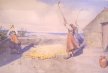
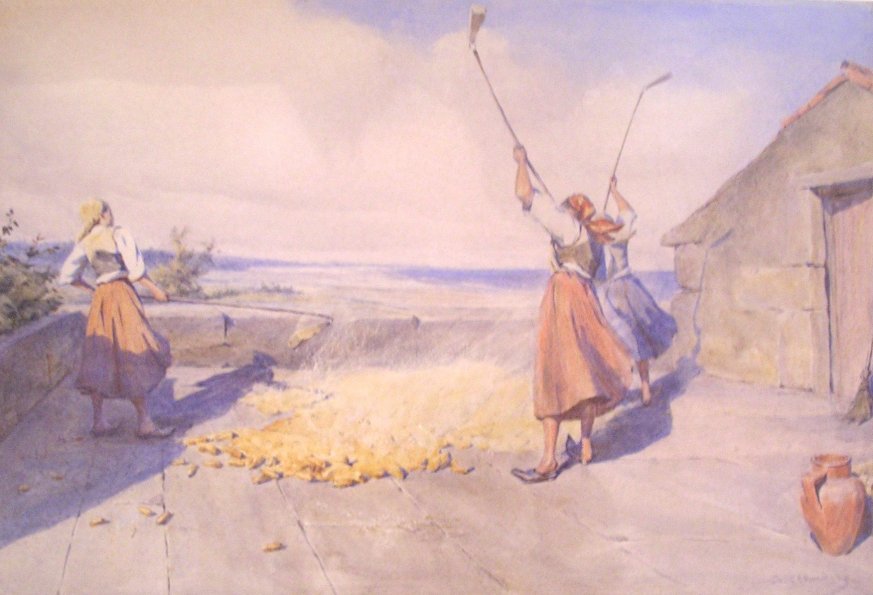
srd087 "Threshing Corn in the Minho"
In Threshing Corn in the Minho - Susanna’s colour sense is at its most characteristic. The warm ochres of the threshing floor, the soft creams and whites of the women's clothing, and the muted greens of the distant hillside form a harmonious palette that is recognisably hers. She balances these warm tones with the cooler blues of the sea and sky, creating a gentle transition of temperature that gives the scene depth and atmosphere. The colour is consistent across the figures and the setting, yet she allows occasional bold notes - a headscarf catching the light, a stronger blue in the water - when the subject naturally calls for them. This painting shows how her restrained palette, careful temperature control, and quiet confidence combine to produce the distinctive colour harmony that runs throughout her work.
Light and the Portuguese Atmosphere
Susanna's Portuguese paintings are shaped by her deep sensitivity to light. Northern Portugal suited her temperament and her working method: its soft Atlantic brightness, its gentle haze, and its quiet rural rhythms aligned perfectly with the calm, observational style she had developed in Surrey. She responded instinctively to the Minho and Douro atmosphere, finding in it a clarity that allowed her to paint with confidence without abandoning her preference for subtle transitions and restrained tonal shifts.
Why Portugal Suited Her - The Minho and the Douro offered a kind of light that matched her artistic personality. The Atlantic air produces a brightness that is strong but not harsh, and a haze that softens distant hills without obscuring them. This was exactly the kind of environment in which Susanna worked best. She could observe clearly, record faithfully, and maintain the gentle tonal balance that defines her work. Portugal gave her subjects that were both vivid and manageable: sunlit walls, pale earth, blue‑grey shadows, and distant hills softened by moisture in the air. These conditions allowed her to paint with freshness while keeping the quiet discipline that characterised her Surrey scenes.

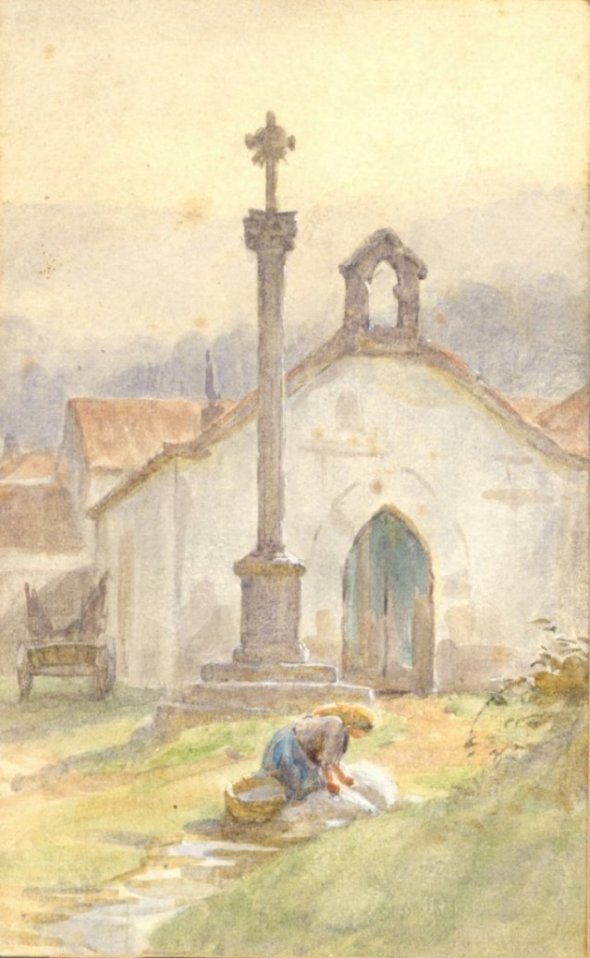
srd030 Washing day
In Washing Day - Susanna's sensitivity to Portuguese light is immediately apparent. The sunlit walls of the chapel are bright but never glaring, and the cool shadows around the washerwoman fall softly across the ground without becoming heavy or dramatic. The distant roofs and hills are gently subdued by the Atlantic haze, creating a natural transition from warm foreground to cooler background. This painting shows how she responded instinctively to the Minho atmosphere: strong light handled with restraint, clear forms softened by air, and a tonal balance that avoids harsh contrasts while preserving the brightness of the day.
Handling Strong Light - Although Portuguese light is stronger than English light, Susanna never exaggerated it. She handled brightness through careful modulation rather than sharp contrast. Sunlit areas are warm and clear, but never glaring; shadows are cool and gentle, not heavy or dramatic. She often placed figures or buildings so that the light fell across them in broad, even planes, allowing her to show illumination without resorting to theatrical effects. Her approach to strong light is therefore observational rather than expressive: she records how light behaves, not how it might be used for drama.
Avoidance of Harsh Contrasts - One of Susanna's most distinctive habits is her avoidance of harsh contrasts. Even in scenes where the sun is strong, she refuses to push darks to extremes. Her shadows remain transparent, her highlights controlled, and her tonal range balanced. This restraint gives her Portuguese paintings a calm, believable atmosphere. It also distinguishes her work from many contemporaries who used Mediterranean or Iberian light as an excuse for bold, high‑contrast effects. Susanna’s Portugal is bright but gentle, clear but never harsh - a landscape seen through the eyes of someone who valued harmony over spectacle.
Sky
Susanna's skies are among the quietest elements in her paintings, yet they play a vital role in establishing the calm, balanced atmosphere that characterises her work. She rarely used dramatic cloud formations or strong tonal contrasts; instead, her skies are gentle, lightly modelled, and carefully judged to support the landscape beneath them. Whether painting in Surrey or Portugal, her sky treatments reveal the same disciplined restraint that shapes her approach to colour and composition.
Her Typical Sky Treatments - Susanna’s skies are usually composed of broad, even washes in pale blue, warm grey, or soft cream. She avoids sharply defined clouds or heavy masses, preferring subtle transitions that create a sense of openness and quiet stability. The sky often occupies a modest portion of the composition, acting as a calm upper register rather than a dominant feature. Even when clouds appear, they are rendered with delicate edges and gentle tonal shifts, giving her skies a natural, unforced appearance.
Her Portuguese skies tend to be slightly brighter, reflecting the Atlantic light, but they remain controlled and understated. In her English works, the skies are cooler and more muted, echoing the softer light of Surrey. Across both regions, her sky treatments are consistent: restrained, harmonious, and always subordinate to the landscape.
How the Sky Supports the Landscape - Susanna’s skies are designed to stabilise the composition and support the forms below them. Their softness prevents the upper part of the painting from competing with the more detailed foreground and middle distance, allowing buildings, figures, and terrain to remain the focus. A pale sky also helps balance her warm earth tones, acting as a quiet counterweight that keeps the colour harmony intact.
In many works, the sky provides the final layer in her spatial structure: a calm, unobtrusive field above the landscape that completes the rhythm of foreground, middle distance, and background. By keeping her skies gentle and understated, she ensures that they enhance the scene without drawing attention to themselves. Her approach shows a painter who understood that the sky need not be dramatic to be effective; it simply needs to be true to the light and supportive of the landscape below.
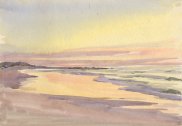
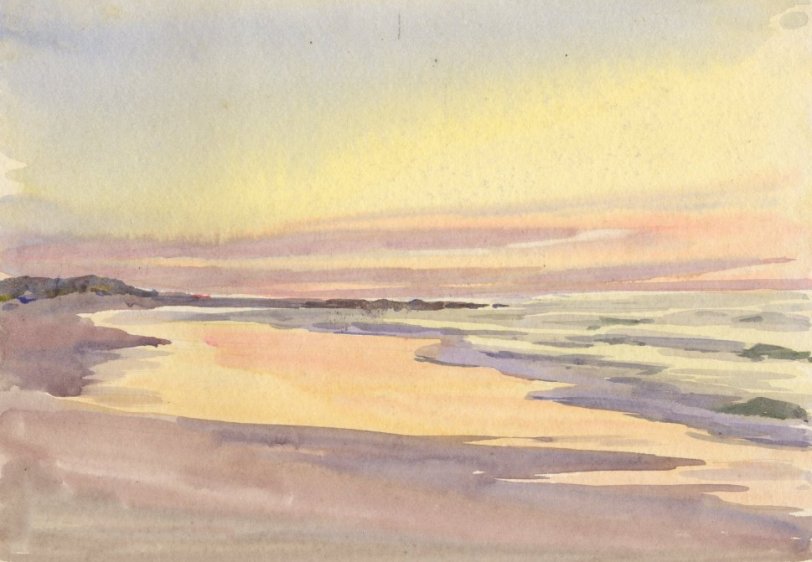
srd331: "Afife" at Sunset.
srd331 "Afife" at Sunset - In this seascape, Susanna's typical sky treatment is shown with exceptional clarity. The sky occupies most of the composition, yet it remains gentle and understated, built from broad washes of pale yellow, soft pink, and lavender that merge without hard edges. There is no dramatic cloud structure and no strong tonal contrast; instead, the sky acts as a calm, luminous field that sets the mood of the entire painting. The sea and shore are rendered with minimal detail, allowing the sky to guide the eye and stabilise the composition. This work demonstrates how Susanna used quiet, carefully modulated skies to support her landscapes, providing openness and balance without ever overwhelming the scene.
Haze and Distance
Atmosphere plays a central role in Susanna’s landscapes, especially in her Portuguese work. She had a natural sensitivity to the way air softens forms, cools colour, and creates depth without relying on strict linear perspective. Her approach to haze and distance is quiet and understated, yet it is one of the most effective tools she used to organise space and give her paintings their characteristic calmness.
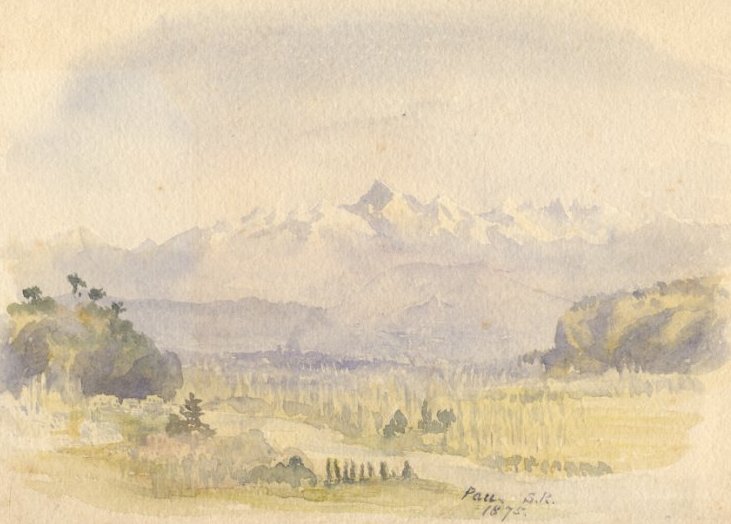
Her Atmosphere Layering - Susanna built her landscapes in gentle layers, moving from warm, clearly defined foregrounds into cooler, softened middle distances and finally into pale, subdued backgrounds. This atmospheric layering allowed her to create depth without exaggeration. She rarely used sharp edges or strong tonal jumps; instead, she relied on gradual transitions of colour and tone to suggest space.
Her haze is never heavy or theatrical. It is a natural part of the scene, arising from the moisture in the Atlantic air or the warmth of the day. Distant hills often appear softened but still legible, their forms reduced to simple shapes and cooler tones. This approach gives her landscapes a believable sense of distance and contributes to the quiet rhythm that runs through her work.
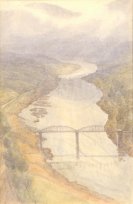
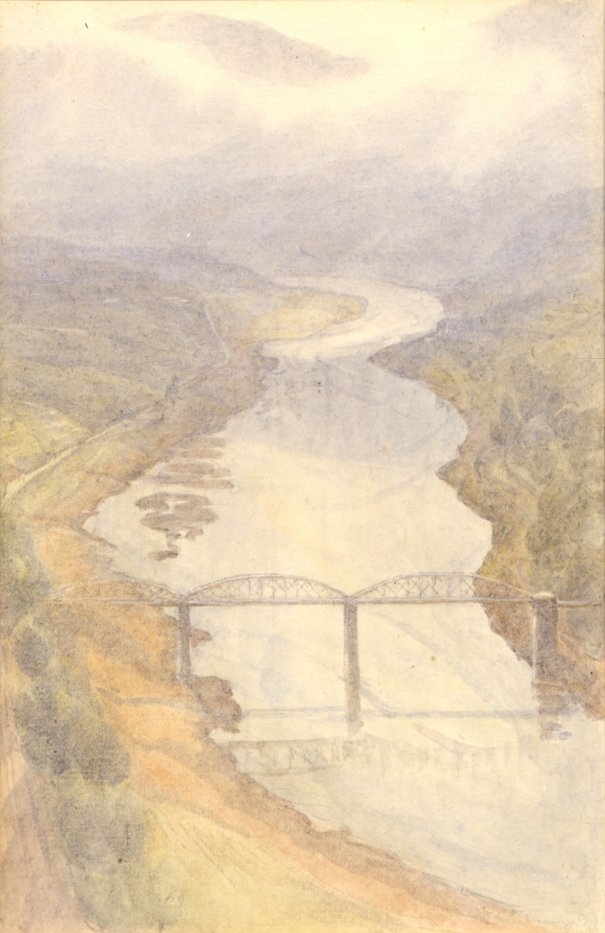
srd116: Railway bridge Across the
Douro.
srd116 - In this river landscape, Susanna’s atmospheric layering is shown with particular clarity. The bridge and near banks are warm and firmly stated, while the river curves gently into cooler tones and softened forms. The distant hills dissolve into pale greys and violets, their shapes reduced to simple masses that recede naturally through haze. The sky is quiet and lightly modelled, completing the rhythm of foreground, middle distance, and background. This painting demonstrates how she used tonal recession rather than strict perspective to create depth in her Portuguese landscapes.
The Douro valley - offered Susanna some of her most atmospheric subjects, and she responded with particular sensitivity. The steep terraces, broad river, and layered hills required a careful balance of clarity and softness. She handled these scenes by reducing distant slopes to cool, simplified shapes, allowing the haze to settle naturally over the far hills while keeping the nearer terraces warm and gently detailed.
Her Douro paintings show how effectively she could manage complex topography without losing harmony. The valley's characteristic brightness is present, but always moderated; the haze is used to organise the scene rather than to dramatise it. By controlling colour temperature and softening distant forms, she created a sense of depth that feels both natural and serene. Her Douro valley handling is therefore a perfect example of her atmospheric discipline: clear, calm, and quietly confident.
Figures and Movement:
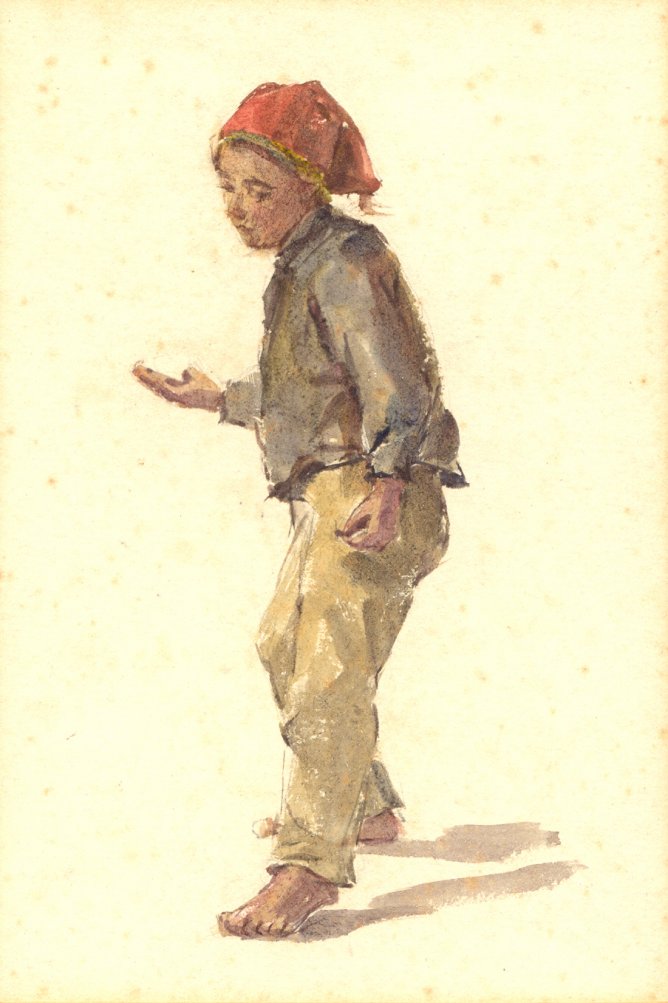
Her Approach to People - Susanna's figures are always integrated into the landscape rather than set apart from it. She paints people as part of the daily rhythm of rural life: washerwomen, threshers, fishermen, children, and small groups engaged in ordinary tasks. Her approach is observational rather than expressive. She does not dramatise gesture or emotion; instead, she records posture, clothing, and activity with quiet accuracy. The figures are usually modest in scale, often placed slightly off-centre, and never dominate the composition. They act as anchors of human presence, giving scale and context to the surrounding landscape.
Her figures are typically simplified, with minimal facial detail and restrained modelling. This is not a weakness but a deliberate choice: she paints people as she paints trees or buildings - as elements of the scene, not as portraits. Their clothing is rendered with gentle tonal transitions, and their movements are suggested through stance rather than through exaggerated gesture. This approach gives her work a calm, documentary quality, reflecting her interest in everyday life rather than theatrical subjects.
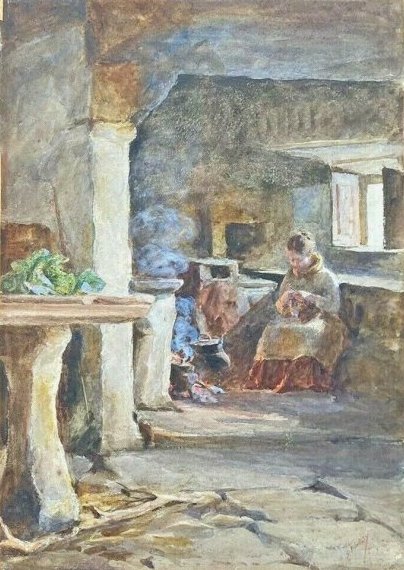
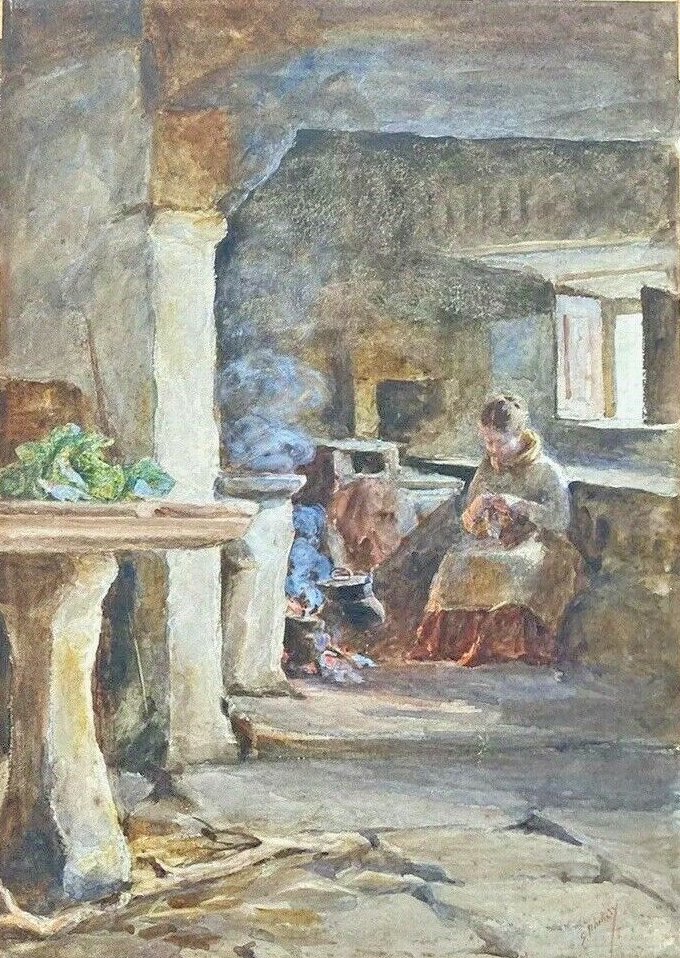
srd513: Women sewing in Room.
Women Spinning Indoors - In this quiet interior scene, Susanna shows her characteristic approach to figures at work. The two women are absorbed in the simple rhythm of spinning, their postures natural and unforced. She gives only the essential details: the tilt of a head, the fall of a shawl, the gentle turn of the spindle. The figures are fully integrated into the rustic room around them, becoming part of its daily life rather than standing apart from it. This painting illustrates her calm, observational manner with people - truthful, modest, and quietly attentive.
Her Sense of Motion - Although Susanna's figures are quiet, they are rarely static. She conveys movement through small, natural cues: a woman bending to lift a basket, a man striding across a threshing floor, children running along a beach, or fishermen hauling nets. The motion is understated but believable, arising from the activity itself rather than from any dramatic flourish. She often places figures in small groups, allowing their collective posture to suggest the rhythm of work or play.
Her sense of motion is strongest in scenes of labour - threshing, washing, carrying, or gathering - where repeated gestures create a gentle visual rhythm. She does not freeze action; instead, she captures a moment within a continuous activity. This gives her paintings a sense of lived time: not a single instant, but a fragment of an ongoing day. Her movement is therefore quiet, natural, and rooted in observation.
Her Limitations - Susanna's limitations with figures arise from the same qualities that make her landscapes so strong. Because she avoided academic training, her anatomy can be inconsistent, especially when figures are seen at unusual angles or in complex poses. Hands and feet are sometimes simplified to the point of vagueness, and crowded scenes can show minor scale inconsistencies. When many figures appear together, the spatial relationships between them are not always fully resolved.
She also tended to avoid expressive faces or dramatic gestures, which means her figures can appear reserved or impersonal. This is not a failure of feeling but a reflection of her artistic priorities: she was more interested in the activity than in the individual. Her figures serve the landscape rather than compete with it. These limitations are modest and do not detract from the overall harmony of her work; they simply reveal the boundaries of an artist who relied on observation rather than formal figure drawing.